This is a shorter post. But it’s an important one if you are a teacher. You’ve heard of Bloom’s Taxonomy, but it’s likely you aren’t sure how to implement it in your classroom.
This article is for you.
Here, we’ll cover:
- The six levels of thought and how they can be applied to any subject.
- The three key elements, cognitive, emotional, and physical, and their importance.
- Bloom’s Taxonomy can help students learn better by assisting them in understanding their own strengths and weaknesses. It can also be used for formative and summative assessment purposes.
We’ll then look at some of the criticisms of Bloom’s taxonomies, and how to deal with them when planning lessons.
Quick refresher on what is Bloom’s taxonomy?
Bloom’s Taxonomic Framework is a way of organizing knowledge into levels. It’s often depicted as a triangle—similar to Maslow’s Hierarchy of Needs.
There are different levels of understanding. At the beginning, you start off at the lowest one, which is called “basic”. Then, you gradually progress to the second one, which is called “competent”. Finally, you reach the highest one, which is called advanced.
Teachers can use Bloom’s Taxonomy by posing multiple choice or true/false type of question to determine students’ levels of knowledge, comprehension, and recall. For instance, they could ask a question like “What is the difference between an object and its properties?” or “How would you compare two different types of people?”. They can then deliver assignments corresponding to Bloom’s Taxonomy’s stages.
A Short History of Bloom’s taxonomy
The 1956 Definition of Bloom’s taxonomy
During World War II, Benjamin Bloom, along his collaborators Max Engelhardt, Edward Furst, William Hill, and David Krathwohn, devised Bloom’s Taxonomic Classification System to classify educational goals into specific categories. They believed that this system would help educators better assess students’ performance.
Every year for the next sixteen consecutive summers, Bloom and his colleagues would revise and refine their taxonomy at the annual meeting of the American Psychological Association. In 1956, they finally published their final version as the Taxonomy of Education Objectives, showing the pathway of educational attainment through six levels of achievement.
After decades of intensive study on education in the U.S. and abroad, my major finding is that almost everyone can be taught anything they want to know, given the right conditions for teaching and studying.
The original taxonomy was used by many different people throughout history to help them assess students, outline clear objectives, and design classroom exercises. However, it soon became a way for teachers to create their own curricula, outline clear objectives, design classroom exercises, and even grade assignments. It has been adapted in classrooms from kindergarten through college and at the university levels.
The 2001 Revised Bloom’s Taxonomy
A group of cognitive scientists, educators, instructional designers, and testing experts organized by Lorin Anderson, a former student of Bloom’s, aimed to reorganize the taxonomic structure of Bloom’s Taxonomies. They created a new set of more dynamic categories than the original, static, one-dimensional ones.
At the heart of the revised version of Bloom’s Taxonomic Hierarchy is the replacement of nouns by verbs—giving students more precise expectations of what they need to achieve.
Why is it important to Understand Bloom’s Taxonomy
•Bloom’s taxonomy has been used by teachers for over five decades to create achievable learning goals.
• The framework encourages instructors to view objectives in behavioral terms, such that they can see what students are capable of as a direct result of instruction received.
• Using the categorization, educators can more effectively organize objectives and create lesson plans with appropriate content and instruction.
• Educators can also design valid assessment tools and strategies to ensure each category is met in turn.
• For students, Bloom’s levels bridge the gap between what they know now, and what they need to learn to attain a higher level of knowledge.
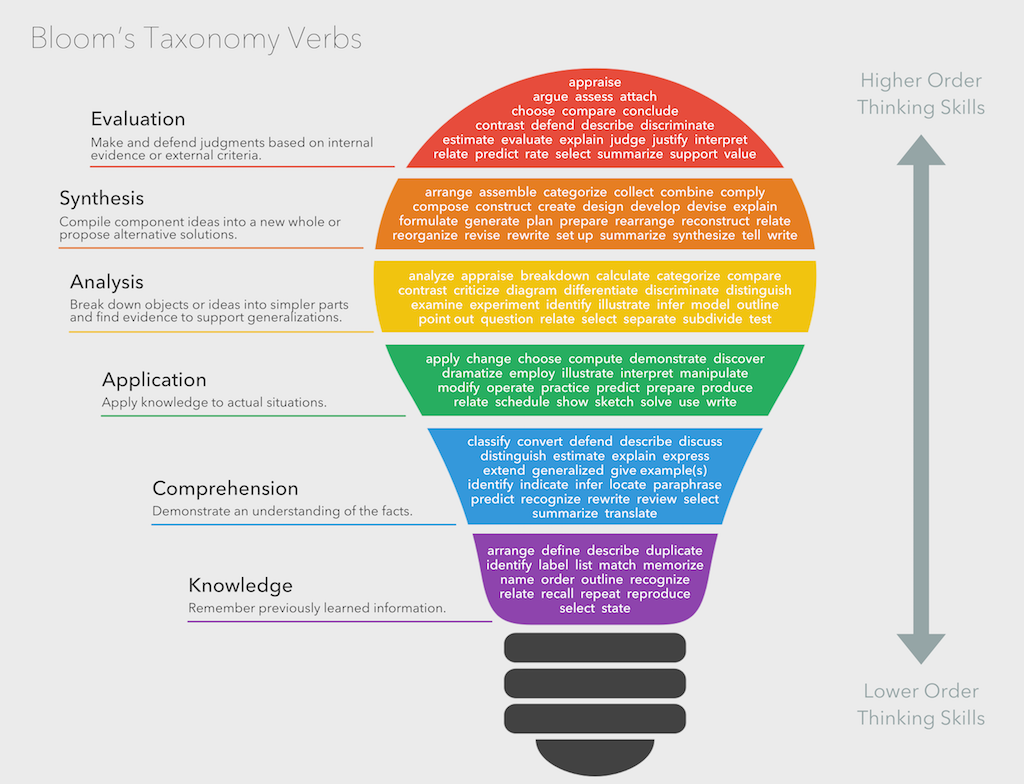
The Six Levels of Thinking In Bloom’s Taxonomy
The levels of thinking in the revised Bloom’s taxonomy are:
- Remember: recalling facts and concepts
- Understand: explaining ideas and concepts
- Apply: using information in new situations
- Analyze: drawing connections between ideas
- Evaluate: justifying a stand or decision
- Create: produce original works
How To Use Bloom’s Levels of Thinking
Bloom’s taxonomy has been used by teachers for a long time to create goals that students can achieve. The framework encourages teachers to think about what students can do as a result of being taught. Using this categorization, educators can better organize objectives and create lesson plans with the right content and instruction. They can also design valid assessment tools and strategies to make sure each category is met in turn. For students, Bloom’s levels help bridge the gap between what they know now and what they need to learn to get to a higher level of knowledge.
Remember, one Bloom’s taxonomy level builds on another. A student needs to remember before they can understand. Likewise, there’s no way a student can analyze or apply without already understanding.
Hopefully this helps make application of Bloom’s Taxonomy a bit clearer!