Why Choose Prefab Modular Cooling for Datacenters?
Prefabricated modular cooling systems offer datacenter operators substantial advantages including deployments in weeks rather than months, scalable pay-as-you-grow flexibility, and up to 40% reduction in labor costs. They achieve PUE ratings as low as 1.1 compared to 1.5-1.8 for traditional systems, provide enhanced reliability with N+1 redundancy, and maximize valuable floor space through compact designs. These benefits combine to deliver ROI within 3-5 years versus the traditional 7-10 year timeline.
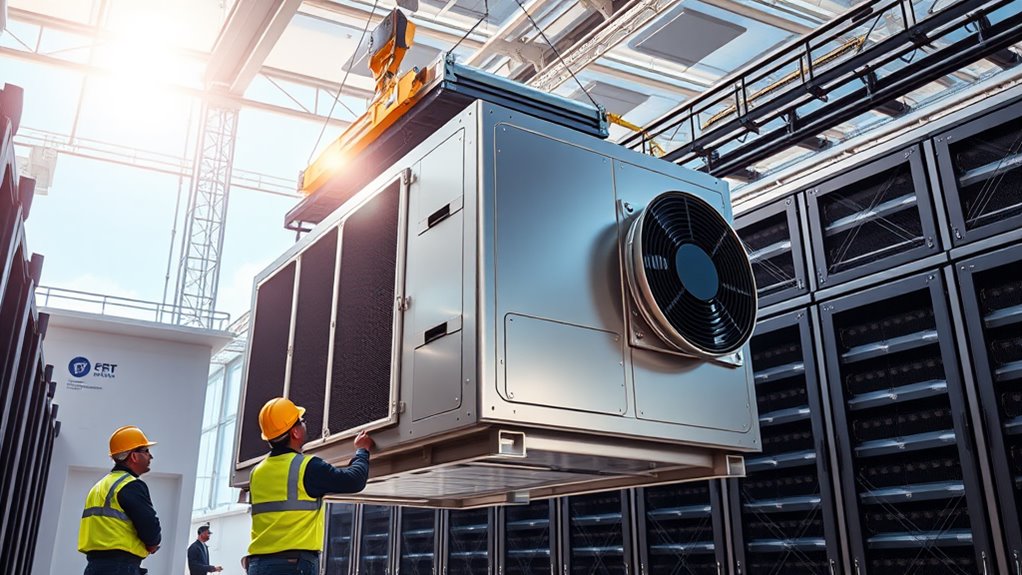
Rapid Deployment and Reduced Time-to-Market
When datacenter operators face growing capacity demands, prefabricated modular cooling systems greatly reduce deployment timelines compared to traditional built-in-place solutions. Facility managers can install prefab solutions in weeks rather than months, delivering immediate cooling capacity while minimizing operational disruptions.
The modular approach eliminates many on-site construction variables that typically delay project completion. Manufacturers pre-engineer, test, and commission cooling modules in controlled factory environments, ensuring they arrive ready for integration. This standardization streamlines site preparation, installation, and operational testing.
For companies competing in fast-moving markets, this acceleration delivers strategic advantages beyond infrastructure improvements. They can respond to business opportunities more aggressively, capture market share during critical windows, and generate revenue from new capacity markedly faster than competitors relying on conventional cooling implementations.
Scalability and Future-Proof Design
Prefabricated modular cooling systems excel in providing datacenter operators with true infrastructure flexibility as business needs evolve. These systems can be scaled horizontally by adding units, or vertically by increasing cooling capacity within existing footprints—a key modular adaptability feature that traditional built-in-place designs cannot match.
Operators can deploy precisely what’s needed today while securing growth potential for tomorrow’s compute densities. When rack densities increase from 10kW to 30kW+, modular systems allow targeted cooling expansions without facility-wide retrofits. This pay-as-you-grow approach aligns capital expenditures with actual business demand.
The standardized interfaces and connection points future-proof the cooling infrastructure against technological cycles, allowing new cooling modules to replace outdated units without disrupting the underlying distribution architecture. Easy to make injection molded parts allow for customization if needed. This design philosophy guarantees datacenters remain viable through multiple IT refresh cycles.
Cost Optimization and ROI Benefits
Three distinct cost advantages emerge when implementing prefab modular cooling systems in datacenter environments. First, reduced capital investment through standardized manufacturing processes eliminates custom engineering expenses while decreasing on-site labor costs by up to 40%. Second, these systems enable precise financial forecasting by removing construction variables that typically lead to budget overruns.
Third, the modular approach creates tangible operational savings through higher energy efficiency ratings (PUE improvements of 0.2-0.3), predictable maintenance schedules, and reduced downtime during installations or upgrades. The pay-as-you-grow model further optimizes cash flow by aligning cooling capacity with actual IT load demands, preventing overcapitalization on unused infrastructure. This strategic deployment model typically delivers full ROI within 3-5 years versus 7-10 for traditional cooling implementations.
Energy Efficiency and Sustainability Advantages
Prefab modular cooling systems achieve markedly lower Power Usage Effectiveness (PUE) values than traditional datacenter cooling solutions, often reaching values as low as 1.1 compared to industry averages of 1.5-1.8. These systems reduce a datacenter’s carbon footprint through precise temperature control mechanisms and intelligent airflow management that minimize energy waste while maximizing cooling capacity. Modern modular designs also incorporate water conservation technologies that can decrease consumption by up to 80% compared to conventional cooling towers, addressing growing sustainability concerns in regions facing water scarcity.
Lower PUE Values
Among the most compelling advantages of modular cooling systems is their ability to deliver considerably lower Power Usage Effectiveness (PUE) values compared to traditional datacenter cooling approaches. These prefabricated solutions routinely achieve PUE ratings of 1.1 to 1.3, representing significant energy efficiency improvements over conventional systems that typically operate at 1.5 or higher.
The lower energy consumption stems from precise thermal management components engineered specifically for datacenter environments. Modular systems deploy targeted cooling exactly where needed, eliminating wasted capacity and reducing overall power demand. Their factory-calibrated settings optimize airflow patterns and temperature deltas, ensuring maximum cooling with minimal energy input. This translates directly to reduced operational costs and enhanced competitive advantage for organizations seeking to dominate their market through superior infrastructure efficiency.
Reduced Carbon Footprint
The environmental impact of datacenter operations extends beyond mere PUE metrics to measurable carbon footprint reduction. Prefabricated modular cooling systems minimize embodied carbon through precision manufacturing that eliminates on-site waste and optimizes material usage. These systems integrate seamlessly with renewable energy sources, allowing datacenters to leverage solar, wind, or hydroelectric power to drive cooling operations with minimal fossil fuel dependence.
Manufacturers increasingly employ eco-friendly materials in modular units, including recycled steel, sustainable insulation, and refrigerants with lower global warming potential. The factory-controlled assembly process enables strict quality control over environmental standards that’s difficult to achieve with traditional on-site construction. This approach delivers dual benefits: operational carbon reduction through efficiency gains and embodied carbon reduction through smarter manufacturing and material selection protocols.
Optimized Water Usage
While traditional datacenter cooling solutions consume vast quantities of water, prefabricated modular cooling systems optimize water usage through closed-loop designs and advanced water recovery technologies. These systems implement sophisticated water conservation techniques that reduce consumption by up to 80% compared to conventional cooling approaches.
Prefab modules feature integrated smart metering that continuously monitors water flow, enabling real-time adjustments to maximize cooling system efficiency. The engineered precision of these units minimizes evaporation and drift losses typically associated with cooling towers. Many manufacturers now incorporate condensate capture systems that reclaim moisture from the air, effectively creating a secondary water source.
This water-conscious design delivers compelling advantages for operators in water-stressed regions, where regulatory compliance and resource costs increasingly impact operational decisions.
Reliability and Performance Enhancements
Three critical factors distinguish high-performing prefabricated modular cooling systems from conventional datacenter cooling infrastructure: redundancy design, intelligent monitoring capabilities, and rapid maintenance protocols. Modular systems deploy N+1 or 2N system redundancy configurations that eliminate single points of failure while maintaining cooling capacity during component servicing.
Advanced performance monitoring integrates with datacenter infrastructure management platforms, providing real-time analytics on thermal conditions, power consumption, and predictive failure detection. These systems automatically adjust to changing loads, optimizing efficiency while maintaining strict temperature tolerances.
The standardized nature of prefab modules enables technicians to perform maintenance 63% faster than with traditional systems. Components are strategically positioned for quick access, and replacement parts are universally compatible across module types, dramatically reducing mean time to repair during critical failures.
Space Utilization and Operational Flexibility
Modern datacenters face persistent space constraints that prefabricated cooling modules directly address through their compact footprint and adaptable deployment options. These systems enable superior space optimization by eliminating the need for dedicated mechanical rooms and bulky cooling infrastructure that traditionally consume valuable square footage.
The modular design delivers exceptional layout versatility, allowing operators to position dehumidifier and cooling assets wherever thermal management is most critical. Units can be installed outside the main facility, on rooftops, or in previously unusable areas, freeing up interior space for revenue-generating IT equipment. Moreover, the standardized dimensions facilitate precise capacity planning and phased deployments that align with business growth.
This operational flexibility empowers datacenter managers to reconfigure cooling resources as heat loads shift, ensuring efficient thermal management without disrupting existing operations.
Frequently Asked Questions About Prefab Modular Data Center Construction
What Regulatory Certifications Do Prefab Modular Cooling Systems Typically Have?
Want to meet global standards? Prefab modular cooling systems typically comply with certification standards like UL, CE, ISO 9001, and ASHRAE, satisfying compliance requirements for safety, energy efficiency, and environmental regulations.
How Do Extreme Weather Conditions Affect Prefab Cooling Module Performance?
Extreme weather impacts cooling efficiency through stress on components and increased workloads. Well-designed prefab modules offer temperature resilience via reinforced housings, adaptive controls, and specialized heat exchange technologies for consistent performance.
What Maintenance Requirements Are Specific to Modular Datacenter Cooling Systems?
Incredibly demanding modular datacenter cooling systems require regular filter checks, scheduled refrigerant monitoring, and timely system upgrades. They’re designed with accessible components and standardized parts that streamline maintenance while maximizing operational efficiency.
How Are Prefab Cooling Modules Transported to Remote Datacenter Locations?
Prefab cooling modules utilize specialized shipping logistics with standardized transport containers. They’re delivered via flatbed trucks, rail systems, or cargo ships depending on site remoteness and access requirements.
Can Prefab Cooling Solutions Integrate With Legacy Datacenter Infrastructure?
Perfectly planned prefab cooling solutions can integrate with legacy datacenter infrastructure through sophisticated integration stra